
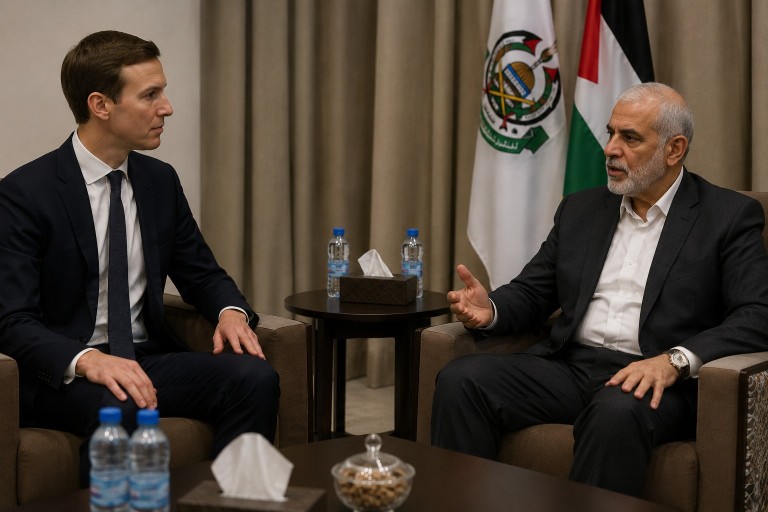
In a significant diplomatic move, Jared Kushner, who serves as Donald Trump’s son-in-law and envoy, met with Khalil al-Hayya, the political chief of Hamas, in Egypt on Sunday. This meeting marked part of a renewed effort by the United States to breathe life into a stalled ceasefire agreement concerning Gaza. Kushner’s discussions in Egypt preceded his scheduled meeting with Israeli Prime Minister Benjamin Netanyahu, who has recently turned down a US-supported 15-point road map aimed at advancing the ceasefire’s next phase.
The proposed plan suggests that Hamas should gradually relinquish its weapons while Israel would cease military operations and pull back from certain areas within Gaza. Additionally, the plan outlines initiatives for reconstruction and the introduction of international forces to bolster security. Despite Hamas expressing its commitment to the proposed road map, it demands that Israel cease its attacks and retreat to the predefined “yellow line” before any plan is implemented. Furthermore, Hamas has linked disarmament of its heavier weaponry to making progress towards establishing a Palestinian state, an idea that faces opposition from Netanyahu’s administration.
Netanyahu has maintained that a full withdrawal of Israeli forces from Gaza will not occur until Hamas is completely disarmed, which has led to a standstill in progressing with essential parts of the ceasefire plan, including reconstruction efforts and the deployment of international peacekeeping forces. To address these challenges, Kushner’s meeting with Hamas included officials from Egypt, Qatar, and Turkey, focusing on securing Hamas’s commitment to disarmament as a crucial step before Kushner’s encounter with Netanyahu.
Further meetings are anticipated between Kushner, Netanyahu, former British Prime Minister Tony Blair, and Nickolay Mladenov, director of the Board of Peace. The rejection of the US-backed roadmap by Israel has drawn criticism from several regional nations, including Saudi Arabia, the United Arab Emirates, Jordan, Pakistan, and Indonesia, all of whom have called for immediate actions to avoid further delays in the process.
This diplomatic push comes at a politically sensitive time for Netanyahu, who faces mounting pressure ahead of Israel’s October election. His coalition government, which includes ministers favoring a more stringent stance on Gaza, poses an obstacle to the future of the ceasefire plan, leaving its success hanging in the balance.