
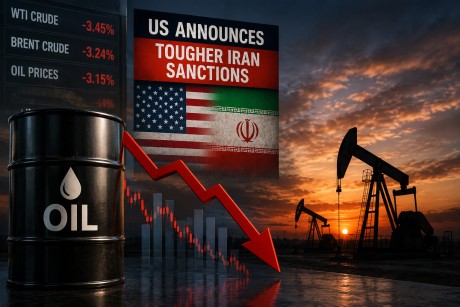
On Tuesday, oil prices took a significant hit, falling over 3% and marking their lowest point in a week. This decline comes as investors weigh the consequences of newly imposed US sanctions on Iran. Brent crude, which serves as the global oil benchmark, decreased by 3.1% to $89.31 a barrel. Meanwhile, West Texas Intermediate (WTI) saw a 3.34% drop, bringing it to $82.17 a barrel. This shift follows a period of growth the previous week when Brent had climbed 6.6% and WTI had increased by 5.7%.
The latest sanctions from the United States are part of a broader strategy to exert pressure on Iran by targeting businesses and countries engaged in economic transactions with Tehran. These measures are designed to further strain Iran’s already fragile economy amid ongoing geopolitical tensions. The oil market’s sensitivity to events around the Strait of Hormuz—a strategic chokepoint for global energy shipments—remains a critical factor in price fluctuations.
Iranian authorities have cautioned that any escalation in US pressure could lead to a disruption of oil exports through the Strait of Hormuz, a vital corridor for the world’s energy supply. Compounding these concerns, shipping in the region has faced heightened risks, highlighted by a recent incident where a tanker was reportedly hit near Oman’s Musandam peninsula. Additionally, persistent attacks in the Red Sea have contributed to the volatility and uncertainty surrounding global oil supplies.
Despite these geopolitical tensions and risks to oil supply routes, the market reacted by focusing on the potential impact of the new US sanctions on Iran’s oil exports. Traders are evaluating whether these measures might substantially affect the country’s ability to continue its oil trade. As the situation evolves, market participants will likely continue to monitor the geopolitical landscape closely while assessing the broader implications for the global energy market.